


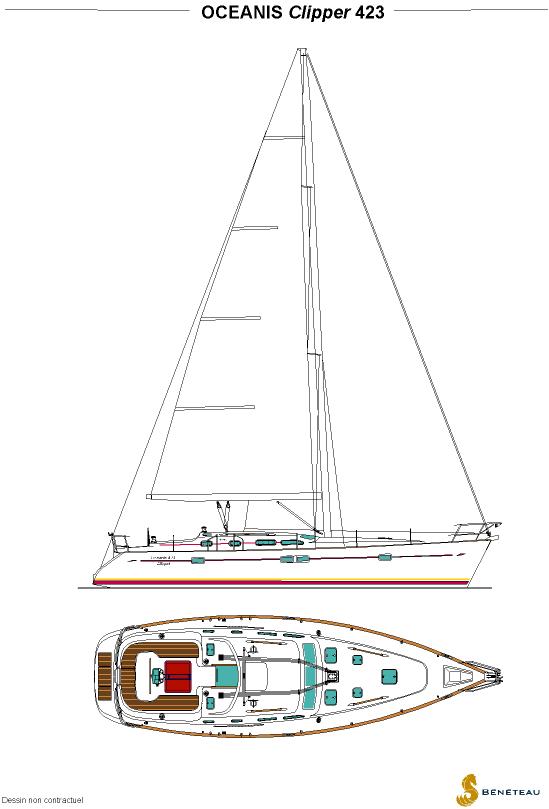
Beneteau Oceanis 423 Summary
Produced between 2002 and 2008, the Beneteau Oceanis 423 (also marketed interchangeably as the Beneteau 423) remains one of the most commercially successful production cruising monohulls in its size tier, with over 330 units sold in the United States market alone. Designed by the French naval architecture firm Groupe Finot, with exterior deck and cabin trunk styling executed by Jeremy McGeary, the vessel was engineered to blend elements of Open 60 ocean-racing hull concepts with high-efficiency production manufacturing. Built to European CE Category A (Ocean) standards, the 423 features a light-displacement hull form, an extended waterline length, generous beam carried well aft, and a low-profile cabin trunk.
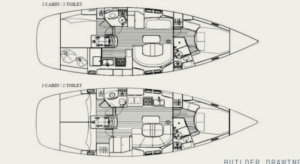
The vessel was built in two primary interior arrangements: a two-cabin owner’s layout featuring an expansive aft galley and a forward master suite with an offset starboard Pullman berth, and a three-cabin charter-oriented layout with a linear portside galley. Auxiliary power is primarily supplied by 55-horsepower Volvo Penta or 56-horsepower Yanmar diesel engines, enabling cruising speeds above 7 knots under power.
Naval Architecture and Design Philosophy
The primary design mandate for the Beneteau 423 was to produce an accessible bluewater cruiser capable of extended passage-making while remaining manageable for a short-handed couple. Groupe Finot implemented key hydrodynamic principles derived from single-handed offshore racing hulls, including a relatively fine bow entry, broad maximum beam positioned well aft, and a wide, powerful transom. This hull geometry generates high initial form stability and maximizes internal hull volume without requiring excessively high freeboard.
The displacement-to-length ratio sits between 148 and 152, establishing the 423 as a light-displacement cruising design. By stretching the waterline length to 38 feet 7 inches relative to its overall length of 41 feet 8 inches (hull length) or 43 feet 2 inches (including stemhead fitting), the designers flattened the underwater canoe body. This shallow canoe body reduces wetted surface area and wave drag.
|
Technical Parameter |
Standard Specification |
Shoal / Optional Variant |
|
Length Overall (LOA) |
43 ft 2 in / 41 ft 8 in hull |
43 ft 2 in (13.16 m) |
|
Length Waterline (LWL) |
38 ft 7 in / 38.55 ft |
38 ft 7 in (11.75 m) |
|
Beam Overall |
12 ft 11 in |
12 ft 11 in |
|
Draft |
5 ft 7 in |
4 ft 9 in Shoal / 6 ft 11 in Deep1 |
|
Displacement (Dry) |
19,000 lbs |
19,797 lbs |
|
Ballast Weight |
5,836 lbs |
5,569 lbs |
|
Ballast Type |
Cast Iron Bulb Keel |
Cast Iron Bulb Keel |
|
Air Draft (Bridge Clearance) |
54 ft 4 in |
53 ft 4 in |
|
Sail Area (100% Foretriangle) |
720 sq ft |
860 sq ft Working Sail Area1 |
|
Sail Area / Displacement Ratio |
16.2 (100% FT) |
18.8 – 18.99 (Working Sail) |
|
Displacement / Length Ratio |
148 – 152 |
148 – 152 |
|
Ballast / Displacement Ratio |
29.9% – 31.0% |
28.1% |
|
Comfort Ratio |
24.65 – 24.97 |
24.65 – 24.97 |
|
Capsize Screening Ratio |
1.92 |
1.92 |
|
CE Certification |
Category A (Ocean)2 |
Category A (Ocean)2 |
Hydrodynamics, Performance, and Handling Dynamics
The hydrodynamic performance of the Beneteau 423 is defined by high initial form stability and low resistance through the water. During sea trials under light-to-moderate conditions (10 to 12 knots true wind), the hull exhibits strong dynamic course stability, holding its line reliably with minimal helm corrections and zero wheel brake pressure.
Helm feedback from the single spade rudder remains light and direct across various points of sail. When sailing close-hauled, the vessel reaches an apparent wind angle limit of approximately 40 degrees, where aerodynamic lift begins to drop off. Cracking off slightly to 42–45 degrees apparent allows the slippery hull form to accelerate quickly, yielding speeds of 6.8 to 7.2 knots on a close reach. On a beam or broad reach (60 to 90 degrees apparent), the boat easily reaches its theoretical maximum hull speed of 8.32 to 8.50 knots.
The light displacement profile and broad, shallow forward canoe body create specific motion characteristics in open water. The high Prismatic Coefficient derived from the full ends and shallow draft reduces wave-making resistance, producing a flat wake and minimal stern squatting under power or sail. With a Capsize Screening Ratio of 1.92 and a Comfort Ratio of 24.65-24.97, the vessel falls within standard offshore safety parameters for monohulls while prioritizing dynamic sailing speed over heavy-displacement damping.
Hull Construction, Grid Framing, and Mechanical Integration
Beneteau constructed the 423 hull using solid, monolithic hand-laid fiberglass infused with polyester resin, meeting European CE Category A Ocean specifications. Overall structural stiffness is achieved through Beneteau’s glued structural inner grid liner system. This fiberglass grid is bonded directly to the inner hull skin, distributing loads from the mast step, chainplates, engine mounts, and keel attachment points across the structure. The deck is manufactured using a balsa-cored sandwich laminate, providing thermal insulation and panel stiffness while keeping weight above the waterline to a minimum.
A design trade-off arising from the shallow canoe body and glued internal grid frame is a shallow bilge network. Because there is minimal bilge depth below the cabin sole, saloon floorboards are screwed down directly rather than left loose for hatch access. This layout limits under-sole storage and requires diligence regarding plumbing, as minor leaks or shaft seal drips can accumulate on top of the grid liner near the sole level.
The standard auxiliary power unit installed on North American production models is the four-cylinder, naturally aspirated Volvo Penta D2-55 (55 hp) diesel engine driving a conventional shaft. European production runs and select export hulls frequently utilized the Yanmar 4JH3E (56 hp) auxiliary engine. The Volvo Penta D2-55 operates at low rotational speeds, running smoothly at a 2,000 RPM cruise to propel the boat at 7.2 knots with low cabin noise. Pushing the throttle to its upper limit of 2,800 RPM drives the hull to its full immersion speed of 8.5 knots.
Shipboard tankage is divided into functional rotomolded units. Fresh water capacity ranges from 143 to 154 gallons (541 to 583 liters) and is carried in integrated bow and stern tanks. Fuel is stowed in a single 53 to 54-gallon (200 to 204-liter) diesel tank located beneath the aft berth, providing an effective cruising range of 350 to 400 nautical miles under power. The electrical layout incorporates 12-volt DC house and engine banks supported by shore power chargers, with many offshore-equipped hulls featuring secondary high-output alternators, solar panels, or bow thrusters.
Rigging, Sail Plan, and Cockpit Design
The Beneteau 423 utilizes a high-aspect masthead sloop rig supported by discontinuous stainless steel standing rigging. Total air draft (bridge clearance) ranges from 53 feet 4 inches to 54 feet 4 inches, allowing the vessel to clear standard 65-foot Intercoastal Waterway (ICW) bridges with a substantial margin. Standard rig dimensions include a mainsail luff of 42.0 to 43.44 feet, a mainsail foot of 14.0 to 14.83 feet, a foretriangle height of 48.0 to 48.65 feet, and a foretriangle base of 16.0 to 16.52 feet.
Starting in 2005, Beneteau USA adopted the Neil Pryde Performance In-Mast Furling (PBF) mainsail with vertical battens as standard equipment. This battened furling system allows for an overlapping roach profile, overcoming the sail area and shape penalties associated with traditional unbattened in-mast furling sails. Classic slab-reefing mainsails with stack-pack lazy bag systems were also offered for performance-oriented owners.
The mainsheet traveler is mounted forward on the cabin trunk, keeping the cockpit clear of sweeping lines. This cabin-top positioning allows for permanent dodgers, biminis, and full cockpit enclosures. However, this mid-boom sheeting arrangement reduces mechanical leverage compared to end-boom setups, increasing loads on the boom and traveler car. Consequently, trimming the mainsail requires a 6:1 tackle purchase or electric cabin-top winches. Furthermore, because halyards and traveler controls are led to winches on the coachroof, adjusting the mainsail from the helm wheel requires an active autopilot when single-handed.
Cockpit ergonomics focus on crew mobility and comfort. The cockpit centers around a fiberglass pedestal housing a 42-inch leather-wrapped steering wheel, primary navigation displays, and a folding cockpit table that acts as a foot brace when heeled. Raised teak-capped bulwarks border the decks, providing security when moving forward, though side decks narrow slightly adjacent to the dodger frame.
Interior Layouts and Spatial Efficiency
The hull volume achieved by Groupe Finot’s design provides substantial living space below decks. The interior is finished in cherry-stained wood cabinetry, complemented by overhead deck hatches and fixed hull ports that provide natural light and horizontal line-of-sight views from the settee. Main saloon headroom is a generous 6 feet 5 inches, tapering gradually forward.
|
Interior Feature |
Two-Cabin Owner’s Layout |
Three-Cabin Layout |
|
Primary Target Market |
Private Cruising Couples / Voyagers |
Charter Fleets / Large Families |
|
Galley Location & Type |
Aft Starboard, L/U-Shape |
Saloon Port Side, Linear |
|
Refrigeration Layout |
Dual Top-Loading Freezer & Front-Loading Fridge |
Top-Loading Combination Unit |
|
Aft Accommodations |
Single Large Port Cabin, Starboard Lazarette |
Twin Symmetrical Double Cabins (Port & Stbd) |
|
Navigation Station |
Port Side Aft of Settee |
Starboard Side Aft of Dinette |
|
Forward Suite Layout |
Starboard Offset Pullman, Forepeak Head |
Starboard Offset Pullman, Forepeak Head |
In the two-cabin owner’s version, the forward master suite spans the space forward of the main bulkhead, featuring a double Pullman berth offset to starboard with drawers and bins beneath. The mattress base lifts on gas struts to access under-bed storage and the forward freshwater tank. To port is a settee, vanity, and hanging locker space. The private forward head in the forepeak includes a sink vanity and a dedicated standing shower stall with an acrylic door.
The two-cabin galley is located to starboard at the companionway base, utilizing an L/U-shape enclosed by a partial bulkhead that provides secure bracing points while underway. Standard equipment includes a top-loading 12-volt freezer, a front-opening 12-volt refrigerator, a gimbaled three-burner Force 10 propane stove with oven, double stainless steel sinks, and deep fiddled shelving.
To starboard in the saloon, a U-shaped dinette seats six adults and lowers to convert into a double berth. A short settee sits to port, with the forward-facing nav station located directly aft. The three-cabin charter layout replaces the aft galley with a long linear galley along the port saloon wall, shifting the nav station to starboard and adding a second symmetrical double cabin to starboard aft.
Pre-Owned Brokerage Market Valuation and Competitive Landscape
Due to strong initial sales, the pre-owned market for the Beneteau 423 remains active across North America and Europe. Resale valuations are strongly dictated by interior layout, overall mechanical hours, rig configuration, and recent bluewater upgrades.
|
Comparative Parameter |
Beneteau Oceanis 423 |
Catalina 42 Mk II |
Jeanneau Sun Odyssey 42DS |
|
Naval Architect |
Groupe Finot1 |
Gerry Douglas / Frank Butler |
Marc Lombard / Garroni |
|
Production Years |
2002 – 2008 |
1995 – 2008 |
2006 – 2014 |
|
Length Overall (LOA) |
43 ft 2 in (13.16 m)1 |
41 ft 10 in (12.75 m) |
42 ft 5 in (12.93 m) |
|
Waterline Length (LWL) |
38 ft 7 in (11.75 m)6 |
36 ft 0 in (10.97 m) |
38 ft 1 in (11.60 m) |
|
Beam |
12 ft 11 in (3.94 m)6 |
13 ft 10 in (4.22 m) |
13 ft 6 in (4.12 m) |
|
Displacement |
19,000 – 19,797 lbs1 |
20,500 lbs |
19,621 lbs |
|
Displacement / Length |
148 – 152 (Light) |
197.0 (Moderate) |
158.0 (Light) |
|
Motion Comfort Ratio |
24.65 – 24.97 |
22.12 |
23.80 |
|
Keel Type |
Cast Iron Bulb2 |
Lead Fin / Wing |
Cast Iron Bulb |
|
Hull Construction |
Solid Fiberglass Monolithic |
Solid Fiberglass Monolithic |
Solid Fiberglass Monolithic |
When compared with its primary market competitors, the Beneteau 423 features a longer waterline and narrower beam than the Catalina 42 Mk II, yielding superior light-air acceleration and a higher theoretical hull speed. However, the Catalina 42 Mk II uses a lead keel—which avoids the rust scaling typical of cast iron—and a higher displacement-to-length ratio that provides a slightly softer motion in heavy swell. Compared to the Jeanneau Sun Odyssey 42DS, the Beneteau 423 has a lower-profile deck trunk, reducing windage under sail while improving forward line of sight from the helm.
Marine Surveyor Inspection Protocol
Surveys of pre-owned Beneteau 423 hulls should focus on several specific structural and mechanical areas:
- Keel Stub and Cast Iron Joint: The 423 utilizes a cast iron bulb keel bedded with polyurethane sealant and bolted through the inner grid frame. Cast iron requires diligent maintenance of its epoxy barrier coating; failure of the sealant joint can cause water ingress and localized rust scale along the keel-to-hull seam.
- Internal Grid Liner Bonding: Structural integrity depends on the bond between the solid fiberglass hull laminate and the inner grid framework. Grounding incidents can cause cracking or delamination of the structural adhesive along the floor frames, particularly near the mast step and keel matrix.
- Shallow Bilge Water Management: Because the shallow canoe body creates minimal bilge depth, the saloon floorboards are screwed down directly. Leaks from hose connections, shaft seals, or air conditioning condensation can pool unnoticed across the inner grid liner, potentially damaging lower cabinetry veneers.
- Cabin-Top Main Traveler Reinforcement: The deck structure beneath the cabin-top traveler and control winches should be examined for core compression or gelcoat stress crazing caused by the high loads of the mid-boom sheeting system.
- Auxiliary Engine Cooling Maintenance: The standard Volvo Penta D2-55 and Yanmar 4JH3E engines feature indirect heat exchangers. Inspection of the heat exchanger tube bundles, raw-water pumps, and exhaust mixing elbows is essential on high-hour vessels.
Conclusion
The Beneteau Oceanis 423 remains a benchmark model among production cruising yachts, successfully combining responsive sailing performance, simple handling, and living comfort. Groupe Finot’s hull shape utilizes a long waterline, light displacement, and broad aft sections to deliver excellent light-air speed and precise tracking. While its shallow canoe body limits bilge depth and leads to occasional pounding in steep chop, these characteristics yield impressive interior volume, great headroom, and bright, comfortable accommodations below. Available in both two-cabin owner and three-cabin charter configurations, the Beneteau 423 continues to be a versatile and liquid option on the global pre-owned market.
__________________________________________________________________
2 Comments